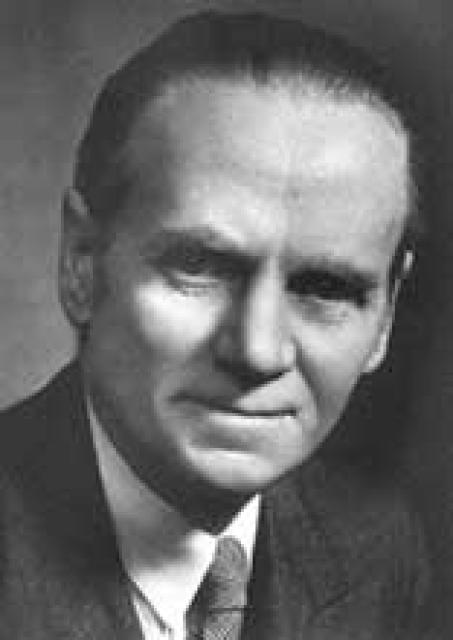
Ralph Norman Angell
 Great Britain
Biography of Ralph Norman Angell
Ralph Norman Angell was an English journalist and pacifist, who was awarded the Nobel Peace Prize in 1933 for his publications in defense of peace. He was born into a large family of prosperous landowner Thomas Angell-Lane. In his early years, his worldview was shaped by his elder sister Carrie and authors such as Herbert Spencer, Voltaire, and Charles Darwin. All biographers note the particular influence of John Stuart Mill's essay on liberty, which he read at the age of twelve.
After receiving his early education in England, Angell was sent to study at St. Omer College in France. He also attended a business school in London and completed a year-long course at the University of Geneva while working for an English-language newspaper published there twice a week. By the time he finished his education, he had come to the deep conviction that the Old World was hopelessly entangled in unresolved contradictions. Therefore, at the age of 17, he made the decision to emigrate to America.
Arriving in the American Wild West, he spent seven years trying his hand at various occupations, including working on vineyards, being a prospector, a cowboy, and a farmer in California, and even a mail carrier. Eventually, he became a correspondent for the "St. Louis Globe-Democrat" and later the "San Francisco Chronicle." After a brief trip back to his homeland in 1898 to settle family matters, he went to Paris. With his experience as a journalist, he became the assistant editor of the Paris edition of the "Daily Messenger," an English-language newspaper.
Simultaneously, he covered the trial of Alfred Dreyfus - an officer of the French General Staff of Jewish origin, who was falsely accused of espionage in favor of Germany. His knowledge of American customs during the Spanish-American War, French chauvinism in the Dreyfus Affair, and British jingoism in the Anglo-Boer War prompted him to write his first book, "Patriotism Under Three Flags: A Plea for Rationalism in Politics" in 1903.
In 1905, he accepted an offer from Lord Northcliffe, a British newspaper magnate, to edit the Paris edition of the "Daily Mail." Only in 1912 did he leave this position to devote himself to writing and giving lectures. By this time, he had gained widespread recognition.
In 1909, Angell published a small book called "Europe's Optical Illusion," in which he explored the economic roots of war. It was in this book that he first used the pseudonym Norman Angell, which later became his trademark. In 1910, he revised and expanded the work, renaming it "The Great Illusion." The book sold two million copies and was translated into 25 languages. It laid the foundation for a theory that became known as "Norman Angellism." According to this theory, as stated in the introduction to the book, "military and political power brings no commercial advantage to a nation, it is economically impossible for one nation to conquer or destroy the wealth of another, or for one nation to enrich itself at the expense of another." In other words, in a condition of economic interdependence, war enriches the aggressor but threatens both the victor and the vanquished. It leads to the destruction of international trade and credit. The payment of post-war reparations by the losing side only sows the seeds of future conflicts.
Over the next 41 years, Angell published 41 books. In "The Fruits of Victory" (1921), he vividly demonstrated the validity of the conclusions of "The Great Illusion." In "The Unseen Assassins" (1933), he highlighted the harmful effects of imperialism, nationalism, and patriotism, and raised questions about the healthy education of ordinary citizens. In addition to his books, he regularly published articles and served as the editor of the authoritative journal "Foreign Affairs" from 1928 to 1931. He was also a member of Parliament and served in the advisory council of the Labour Party. In 1931, he was knighted and became a member of the Royal Institute of International Affairs.
For nearly half a century, Angell embarked on "lecture tours" almost every year, with his last one taking place at the age of 90, spanning two months and covering various cities in the United States. He passed away at the age of 94 in a nursing home in Croydon, Surrey, on October 7, 1967.
Works:
- Angell, Norman, "After All: The autobiography of Norman Angell." London, Hamish Hamilton, 1951;
- "Arms and Industry: A Study of the Foundations of International Policy." New York and London, Putnam, 1914;
- "Europe's Optical Illusion." London, Simpkin, Marshall, 1909;
- "The Fruits of Victory: A Sequel to 'The Great Illusion'." London, Collins, 1921;
- "The Great Illusion: A Study of the Relation of Military Power in Nations to Their Economic and Social Advantage." London, Heinemann, 1910;
- "Patriotism under Three Flags: A Plea for Rationalism in Politics." London, Unwin, 1903;
- "The Unseen Assassins." London, Hamish Hamilton, 1932.


