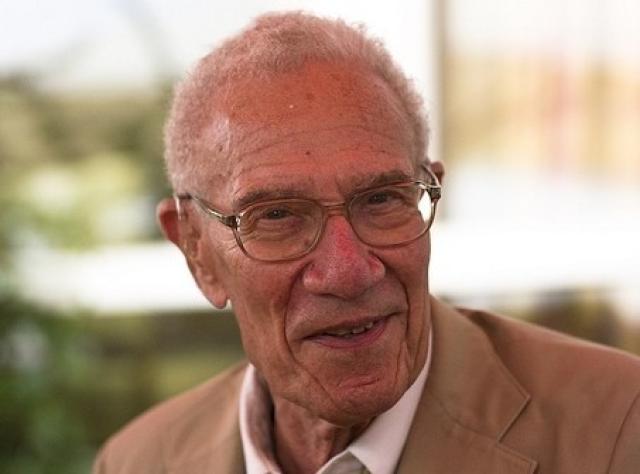
Robert Merton Solow
 USA
USABiography of Robert Merton Solow
Robert Merton Solow is an American economist renowned for his research on the theory of economic growth. His groundbreaking work led to the development of the "Solow model," a unique model that describes the principles of exogenous economic growth based on technical progress, labor, and capital. Solow was honored for his research with the John Bates Clark Medal and the Nobel Prize in Economics.

Early Life and Education
Solow was born in Brooklyn, New York, into a Jewish family and was the oldest of three children. He attended a local public school, where he excelled academically from an early age. In September 1940, on a scholarship, Solow enrolled at Harvard College, focusing his studies on sociology, anthropology, and elementary economics. In late 1942, he left the university to join the United States Army. Solow spent some time in North Africa and Sicily, fighting in Italy during World War II. In August 1945, he was discharged from the army and returned to Harvard.

Research and Career
Under the guidance of Wassily Leontief, Solow conducted his first significant research and calculated the first set of capital coefficient for input-output analysis. He later became interested in statistics and probability models. From 1949 to 1950, Solow worked at Columbia University, combining his study of statistics with his doctoral dissertation, which aimed to expand existing models to account for income distribution using interacting Markov processes to calculate unemployment and wage coefficients.

In 1949, Solow was offered a position as an assistant professor at the Massachusetts Institute of Technology (MIT) economics department. There, he taught econometrics and statistics. Over time, Solow became increasingly interested in macroeconomics. For nearly 40 years, he collaborated with Paul Samuelson, contributing to the development of significant theories such as the von Neumann growth theory, capital theory, linear programming, and the Phillips curve.
Solow held various government positions, including senior economist in the Council of Economic Advisers and member of the President's Commission on Income Maintenance. During this time, his research focused on capital theories, growth policies, and unemployment issues. In 1961, the American Economic Association awarded Solow the John Bates Clark Medal as an "outstanding economist under 40." In 1979, he served as the president of the association.
In 1987, Solow's analysis of the principles of economic growth earned him the Nobel Prize in Economics. In 1999, he received the National Medal of Science. Currently, Solow serves as the president of the Cournot Centre for Economic Studies, which he founded in 2000. He is also a trustee of the Economists for Peace and Security group.
The Solow model, also known as the Solow-Swan neoclassical growth model, was originally discovered by Trevor W. Swan in 1956, completely independent of Solow. However, Solow further developed the model and was able to calculate approximately 4/5 of the per capita income in the United States, particularly in relation to technological progress.


