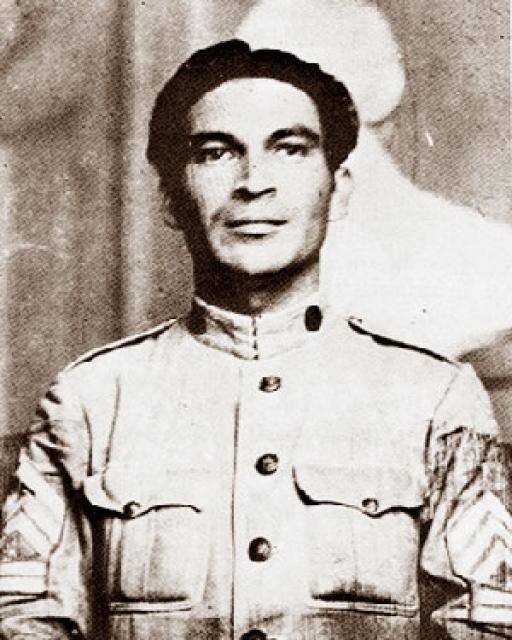
Ruben Batista-I-Saldivar
 Cuba
CubaRuben Batista y Zaldivar - A Biography
Ruben Batista y Zaldivar was a two-time dictator of Cuba, ruling from 1933-1944 and 1952-1959. Known for his unprincipled and corrupt methods of governance, he was heavily supported by American capital. Batista was born on January 16, 1901, and served as a sergeant in the Cuban army.
Together with Pablo Rodriguez, Batista led the conspiratorial organization "Military Union of Colombia," named after a military town in Havana. This union played a significant role in overthrowing the dictator Machado in August 1933. However, the government led by Manuel de Cespedes was also unsatisfactory to the sergeants. The Military Union, along with several other organizations opposing Cespedes, initiated the creation of a Revolutionary Junta, which aimed to form a government capable of resisting American influence. By that time, Cuba could be de facto considered a semi-colony of the United States.
On the night of September 5, 1933, the junta seized power, and a Government Executive Commission was formed, led by Professor R. Grau San Martin. The sergeants, who managed to rally the main mass of soldiers, took control in the provinces. However, the Temporary Government soon faced a struggle between supporters and opponents of contacts with the United States. The head of the government, Grau San Martin, belonged to the pro-American faction.
Nevertheless, the US did not rush to recognize the Temporary Government. They promised to recognize it if it could "maintain order." Despite calls from the Senate to exercise caution, President Roosevelt still sent ships to Cuban waters. Washington's reaction was influenced by what it perceived as the radical plans of the Temporary Government, which advocated "Cuba for Cubans." However, the powerful neighbor worried in vain. The junta, despite its declarations, focused all its efforts on seeking recognition from Washington. It quickly announced that it had nothing to do with communists and was committed to fulfilling previous agreements with foreign states and their financial obligations. The government actively sought to undermine the influence of labor unions and deployed troops to disperse worker demonstrations and protests.
Nevertheless, all the right-wing forces in the country, supported by the US Embassy, opposed the government. Several military uprisings followed one after another. Batista, who became a colonel and chief of the General Staff, used the power of the army to his advantage, initially supporting the Grau government to strengthen his own position and later undermining it to consolidate his power. Batista led the right-wing faction of the Temporary Government, while the left-wing faction was led by 27-year-old Minister of Defense and Interior, Antonio Giteras, who criticized Batista's orders to attack union facilities and disperse demonstrations.
Giteras refused to accept an unofficial visit from the new US ambassador to Havana, D. Caffery, indicating to the diplomat that his attempt to enter the Ministry of War without going through official channels was a provocation. However, Giteras frequently and willingly met with the American ambassador, which Giteras openly protested against at a cabinet meeting, demanding that Batista be replaced with Rodriguez, known for his patriotic views. In response, Batista imprisoned Rodriguez. Giteras went there, freed the prisoner, and together they addressed the people in the central square of Havana.
The ambitious colonel ordered the shooting of the gathered crowd. As a result, Grau San Martin was forced to resign. Since then, using his unelected position as Chief of Staff and influence in the army, Batista ruled the country through puppet governments until he was elected president in 1940.
The United States, in contrast to San Martin, immediately recognized Batista's government. Washington announced its readiness to start negotiations with him to amend the trade agreement, which was considered cabalistic in its essence. The US government retreated under pressure from revolutionary events in Cuba. In the US, they understood that maintaining the odious "Platt Amendment," which gave them the opportunity for military intervention in Cuban affairs, united anti-American sentiment. Additionally, the US had to maintain the reputation of President Roosevelt's policy of goodwill.
On May 29, 1934, US-Cuban negotiations ended with the repeal of the Platt Amendment and the signing of a new agreement between Cuba and the United States. This was a significant achievement of the 1933-1934 revolution.
In March 1935, the situation in the country heated up again. On March 12, a general strike began involving about 700,000 people, but it only lasted a few days. Encouraged by the American ambassador, Batista took extreme measures: the government flooded the railways with troops, occupied major cities under the pretext of self-defense, and allowed strikebreakers to kill strikers with impunity. The strike was suppressed.
In May, Antonio Giteras was killed. Seeing the futility of his hopes for the formation of a unified revolutionary front, Giteras decided to emigrate to Mexico. Batista learned about his plans and surrounded Giteras, who was waiting on the coast for a yacht that was supposed to take him aboard. As a result of the ensuing shootout, Giteras was killed.
After suppressing the revolution in 1935 and achieving dictatorial power, Batista began to set his sights on the presidential seat. However, he understood that he could only become president by gaining the trust of the leaders of the main bourgeois parties and gaining popularity among voters. Therefore, while pursuing his intended goal, Batista strengthened his position in the army and flirted with the masses.
By 1935, Batista had created a powerful military apparatus, equipped the army with new weapons purchased from the US, including hydroplanes and bombers, rebuilt the military town of Colombia, increased the salaries of servicemen, and had a force of 30,000 soldiers ready to suppress "internal enemies" at his first command.
In preparation for his candidacy for the 1940 presidential elections, Batista announced plans to build schools for peasant children and agricultural workers, expand the pension system, and implement extensive construction programs to combat unemployment. To finance this plan, Congress passed a bill imposing a special tax on each bag of raw sugar produced in Cuba.
In 1936, Manuel Gomez, recommended by Batista, was elected president. Unlike San Martin, the United States immediately recognized Gomez. Washington announced its readiness to negotiate a change in the trade agreement, which was considered cabalistic. The US government retreated under the pressure of revolutionary events in Cuba. In the US, they understood that maintaining the odious "Platt Amendment," which gave them the opportunity for military intervention in Cuban affairs, united anti-American sentiment. Additionally, the US had to maintain the reputation of President Roosevelt's policy of goodwill.
In 1937, the atmosphere in the country heated up again. On May 1, a grand demonstration took place under anti-fascist and democratic slogans. The memory of the tragic end of dictator Machado, in which Batista himself played a role, also held him back.
Batista granted amnesty, released political prisoners, allowed the revival of the "Cuban Workers' Confederation," which had been operating underground as the National Confederation of Cuban Workers since 1955. In April 1939, a law was passed to hold elections for a Constituent Assembly, and the elections were set for November. It seemed that Batista was creating an environment that would allow for democratic elections.
These circumstances largely disoriented the opposition forces. It was difficult to avoid mistaken assessments when the authorities allowed the legal activities of communists, the free distribution of their newspaper "Noticias de Hoy," and the legalization of other opposition organizations, including the "Young Cuba" organization created by Giteras. Many political leaders were allowed to return from exile. At the end of 1939, the founding congress of the Cuban Workers' Confederation, which brought together over 800 trade unions with over 300,000 members, took place. The National Peasant Federation was created in the summer of the same year.
In 1940, a new constitution was adopted, which limited latifundia and the influence of monopolies and foreign capital in the country. The state retained all rights to subsoil; there was a right to confiscate property that did not benefit society; equal voting rights were provided for all citizens of the republic - men and women over the age of twenty.
In the presidential elections in July 1940, F. Batista emerged as the winner. The political activism of the masses, triggered by the start of World War II, forced Batista to continue a policy that was not in line with his internal convictions. He went on to nationalize part of the railways (October 1942), established diplomatic relations with the Soviet Union, and, in December 1941, after the US entered the war, Cuba declared war on Japan, followed by Germany and Italy a few days later.
The difficulties of the war mainly affected Cuba in the economic sphere. The transportation of sugar became more difficult, prices of coal, oil, and car tires sharply increased, and there was a shortage of these goods. Food shortages led to the formation of a black market in the country. Corruption among government officials increased, and inflation rose.
While there was some democratization of public life during Batista's regime, none of the most acute economic problems were solved.
The sugar industry, the most important sector of the Cuban economy, remained in the hands of foreign monopolies, mainly American. Two-thirds of Cuban imports and three-quarters of exports were related to trade with the US.
In the 1940s, the entire mining industry in Cuba came under the control of American companies, as did all electricity production facilities, telephones, telegraphs, and 50% of the service sector. Nearly 80% of the fuel consumed in the country was supplied by US oil monopolies. The Cuban economy remained in a state of chronic crisis.
The Cuban national bourgeoisie, seeking to improve their position, failed to develop industries unrelated to sugar production, despite some increase in profits due to the war. This, along with dissatisfaction caused by Batista's hasty personal enrichment, to some extent determined the outcome of the 1944 elections, in which the leader of the opposition, Grau San Martin, emerged as the victor. After his defeat, Batista went to Florida to rest.
In 1948, Carlos Prio Socarras, a member of the Republican Party, became president. Socarras faced sharp criticism from the right-wing opposition for not having a "firm enough rule." Batista took this into account and began to orient himself towards the right.
The "sergeant" also took into account the new trends on the continent, the "Cold War" that began after World War II. In 1949, the Cuban government established a group to combat subversive activities. Following the United States, anti-communism became Cuba's state policy. Socarras, under pressure from Washington, attempted to send 25,000 Cuban soldiers to the Korean War. Apart from lives, this venture was expected to cost Cuba $100 million. Protests against such an obvious adventure erupted throughout the island, even within the army.
The strengthening of the left forces forced the search for a "strong personality." General Batista had just returned from the US. His choice was influenced by two factors: the general was unquestionably loyal to Washington and enjoyed significant authority in the army, despite forcing his supporters to resign under San Martin.
When embarking on a coup, Batista carefully weighed all the pros and cons. The moment was quite suitable: the government of Socarras had completely discredited itself, and the important military and police centers of the country were ready to support the rebels.
On the night of March 10, 1952, Batista appeared in the military town of Colombia. By evening of the same day, he was already seated in the presidential palace. The coup took place bloodlessly.
After returning to power for the second time, Batista behaved much more harshly and ruthlessly than in the first period of his rule. He annulled many of his own initiatives, including canceling the 1940 constitution and severing diplomatic relations with the Soviet Union. These measures were carried out within the framework of the "Cold War" politics. In the Western Hemisphere at that time, anything remotely resembling communism in its Soviet variant was feared.
Batista regularly delivered speeches expressing his hatred for communism.
The government's economic policy contributed to a significant strengthening of American capital's position in the Cuban economy. A series of agreements with the US opened up broad opportunities for transferring profits from Cuba to the mainland. American companies were granted extremely favorable concessions in mining, oil exploration, and the sale of gasoline on the island. In the first year of Batista's rule, about 100 new American companies began operating in the country. American bank branches in Cuba held a quarter of all deposits in the country.
During Batista's regime, American companies exported at least $800 million in net profits from Cuba. As a result of the "price scissors" between Cuban and American goods, Cuba lost at least $2 billion in the 1950s.
Batista's economic policies led to a significant increase in the influence of American capital in the Cuban economy, exacerbating the country's dependency and chronic crisis.
Batista's rule was characterized by repression, corruption, and the strengthening of American economic dominance. His government maintained stability by suppressing any opposition and favoring the interests of the ruling elite and foreign capital. These policies eventually created the conditions that led to the Cuban Revolution in 1959.