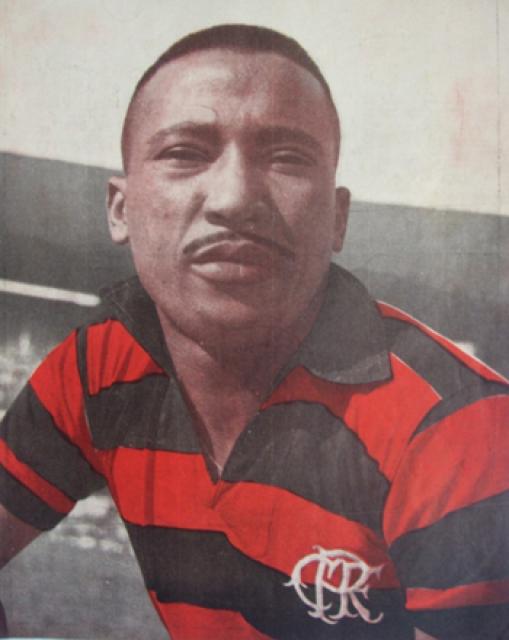
Rubens Josue Costa
 Brazil
Rubens Josué da Costa (24 November 1928 – 31 May 1987), known simply as Rubens and affectionately nicknamed “Doutor Rúbis,” was a Brazilian attacking midfielder. Elegant on the ball and known for setting up attacks, he became a standout at Flamengo, where he helped win three consecutive Rio state championships from 1953 to 1955. He later played for Vasco da Gama and was part of Brazil’s squad for the 1954 World Cup.
From Ypiranga to Flamengo
Born in São Paulo, Rubens began his professional career with Ypiranga, the club where he had developed as a young player. He also had a short spell at Portuguesa before joining Flamengo in 1951. The move brought him to Rio de Janeiro at a moment when the club was rebuilding after the departure of star Zizinho.
Rubens soon won over Flamengo supporters. Operating in midfield, he was valued for his close control, passing and ability to organize attacks. Fans called him “Doutor Rúbis,” a playful nickname that became inseparable from his reputation. His partnership with fellow midfielder Dequinha helped give Flamengo a balanced, creative center to its team.
Flamengo’s championship years
Rubens was an important part of Flamengo’s second three-peat of Rio state titles, won in 1953, 1954 and 1955. The side combined his playmaking with a strong supporting cast, and the titles made him one of the team’s leading figures of the decade. His name also found its way into Wilson Batista’s popular samba “Samba Rubro-Negro,” which celebrated Flamengo and singled out Rubens alongside Dequinha and defender Pavão.
He also represented Brazil internationally. Rubens was part of the national team that won the 1952 Pan American Championship in Chile and was selected for the 1954 FIFA World Cup in Switzerland. Brazil’s campaign ended in the quarter-finals, where the team lost a heated match to Hungary. His selection reflected the standing he had earned through his club performances.
Vasco and later career
After leaving Flamengo, Rubens joined Vasco da Gama in 1957. The transfer between Rio rivals was a major change, but he continued to contribute at a high level. In 1958 Vasco won both the Rio state championship and the Rio–São Paulo Tournament, adding another successful chapter to his career.
Rubens went on to play for Santa Cruz and clubs in São Paulo state, including Prudentina. Across teams, he remained best remembered as a midfielder who could dictate the rhythm of a match and turn possession into dangerous attacks. His years at Flamengo, in particular, placed him in the club’s history as a central figure of its 1950s side.
Final years and legacy
Rubens died in Rio de Janeiro on 31 May 1987, aged 58, from lung cancer. The affectionate “Doutor Rúbis” nickname and memories of his skillful midfield play have endured among Flamengo supporters. His role in the 1953–55 title-winning team, his later success with Vasco, and his place in Brazil’s 1954 World Cup squad made him a notable figure in Brazilian football’s postwar generation.



