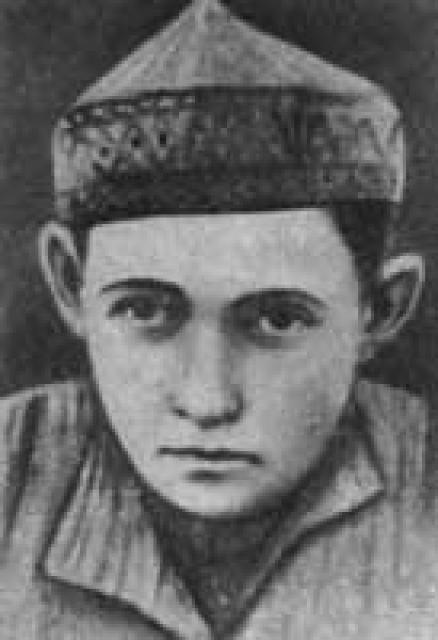
Semen Ostapenko
 Ukraine
- Biographical Information about Semyon Ostapenko
- Participation in the Underground Organization "Young Guard"
- Arrest and Execution
Biographical Information about Semyon Ostapenko
Semyon Ostapenko was born on May 10, 1927, in the village of Pyatigorovka in the Novosvetlovsky district of the Voroshilovgrad region, in a working-class family. In 1929, his parents moved to the city of Krasnodon. Semyon had a calm and balanced character. From 1934 to 1942, he studied at School No. 1 named after A.M. Gorky. He read a lot, especially enjoying Taras Shevchenko's "Kobzar," Nikolai Gogol's works, and Nikolai Ostrovsky's "How the Steel Was Tempered." He was passionate about sports, drawing, and playing the balalaika. For his academic achievements and active participation in school life, Semyon Ostapenko was awarded a travel voucher along the Dnieper River in 1940. His long-standing dream came true - to see and sail along the river described by his favorite writers, Gogol and Shevchenko.
Participation in the Underground Organization "Young Guard"
In the summer of 1942, Semyon completed the 7th grade. Like many of his peers, he dreamed of going to the front lines and fighting alongside the Red Army soldiers, performing heroic acts. In the evenings, he would draw by the light of a smoking lamp. On a sheet of paper, his boyish fantasies came to life - a Red Army soldier in a Budenovka hat with a saber, strong and unwavering in his belief in victory, like Taras Bulba. When Krasnodon was occupied, Semyon joined Sergey Tyulenyin's group, which later merged with the underground Komsomol organization "Young Guard." Like other members of the "Young Guard," he copied and distributed leaflets and collected weapons. On the orders of the headquarters, he delivered grenades and ammunition from a warehouse located at mine No. 22.
From Commander Ivan Turkenich's report on the "Young Guard," we learn that Semyon Ostapenko retrieved weapons from a hiding place in the yard of the house where the head of the fascist labor exchange lived. Together with Sergey Tyulenyin, Vladimir Osmukhin, and Demian Fomin, he seized the herd of cattle confiscated by the fascists from the local population. "And once, when Solikovsky had a gathering," recalls Valeria Borts, "Semyon Ostapenko cut the electrical wires, and the evening was spoiled." To fulfill the combat tasks, the headquarters needed a map of the city, and Semyon took on the task of creating it. He was also assigned to cut out rubber fonts necessary for printing leaflets (before the underground printing press was established). At one of the meetings of the "Young Guard" headquarters, Semyon was accepted into the ranks of the Lenin Komsomol.
Arrest and Execution
On January 27, 1943, Semyon Ostapenko was arrested. Torture and torment continued at the Rovenkovskaya gendarme station, where Semyon was brought on January 31, and on February 9, he, along with Oleg Koshev, Lyuba Shevtsova, Dmitry Ogurtsov, and Viktor Subbotin, was shot by the fascists in the Treacherous Forest. After the liberation of Rovenki, the heroes were buried in a mass grave of the victims of fascism in the city center, in the park named after the "Young Guard." Semyon Markovich Ostapenko was posthumously awarded the Order of the Patriotic War, 1st Class, and the Medal "Partisan of the Patriotic War," 1st Class.