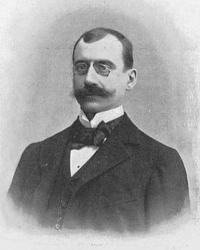
Sergey Botkin
- Sergei Dmitrievich Botkin
- Diplomatic Career
- - Assistant in the Asian Department
- - First Secretary of the Embassy in Constantinople (1909-1911)
- Ambassador and Head of Emigrant Organizations
- Later Years and Death
- Family
Sergei Dmitrievich Botkin
Sergei Botkin, a Russian diplomat and emigrant, was born into a wealthy family of hereditary honorary citizens. His father, Dmitry Botkin, was an avid collector of foreign paintings. Sergei graduated from the law faculty of Moscow University in 1892 and joined the Ministry of Foreign Affairs that same year.
Diplomatic Career
Botkin held various diplomatic posts throughout his career, including:
- Assistant in the Asian Department
- Second Secretary of the Russian Mission in Stuttgart (1897)- Second Secretary of the Russian Mission in Bern (1900-1904)
- Second Secretary, then First Secretary of the Embassy in Vienna (1904-1909)
- First Secretary of the Embassy in Constantinople (1909-1911)
- First Secretary of the Embassy in Berlin (1911)He was appointed chargé d'affaires in Darmstadt in 1914, but due to the outbreak of World War I, he did not assume this position and returned to Russia with other diplomats. During the war, he headed the temporary department for prisoners of war at the central office of the Ministry of Foreign Affairs.
Ambassador and Head of Emigrant Organizations
From 1919 to 1920, Botkin served as ambassador of (White) Russia to Berlin (governments of Kolchak and Denikin). He simultaneously headed the Russian Red Cross until 1936. In the same period, he led the Organization for the Protection of the Interests of Russian Refugees in Germany.
In 1924, Botkin became chairman of the Berlin Holy Prince Vladimir Society, which he had revived in 1923. He also served as chairman of the Imperial Palestinian Society and was a member of the Russian Geographical Society.
Later Years and Death
After the Nazi Party came to power in Germany, the regime began to pressure Russian emigrant organizations, seeking to control them. Botkin faced machinations by Prince Masalsky, who slandered him as "pro-French." Botkin left for Yugoslavia and later Paris, where he remained due to health reasons. In 1936, Germany refused him a visa and "expelled" him, forcing him to remain in Paris for the rest of his life.
Sergei Botkin died in Paris and was buried at the Russian cemetery of Sainte-Geneviève-des-Bois.
Family
Botkin was married to Nina Bütsova, daughter of a Russian diplomat. Their daughter, Nina Belevsky-Zhukovskaya, married a descendant of Emperor Alexander II. His cousin, Evgeny Botkin, was the imperial physician who was executed with the royal family.