Stefan Mallarme
 France
- Symbolism's Guiding Light
- A Poetic Odyssey
- Parnassian and Decadent Inclinations
- Symbolism's Pioneer
- Poetic Innovation and Symbolism
- The Unfulfilled Promise
- The Legacy of a Poetic Visionary
Symbolism's Guiding Light
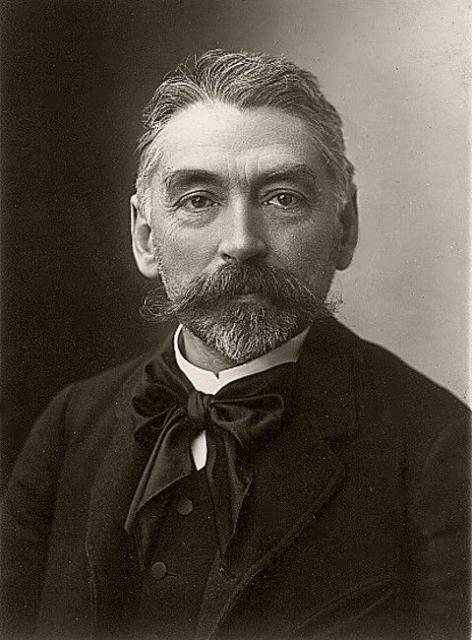
Early Life and InfluencesStéphane Mallarmé, a renowned French poet and writer, emerged from a family of humble origins. Born in 1842 as the son of a civil servant, he experienced an early loss when his mother passed away at the young age of five. Raised by his maternal grandparents, Mallarmé was a sensitive child who immersed himself in literature at an early age.
His formal education began at the religious boarding school in Auteuil in 1852 and continued at the Lycée de Sens in 1853. These formative years proved to be challenging, and the loss of his beloved 13-year-old sister, Marie, in 1857 further intensified his feelings of solitude.
Despite his father's desire for him to pursue a career in civil service, Mallarmé's passion for poetry burned brightly within him. He earned his baccalaureate degree in 1860 and embarked on a journey that would forever alter the face of French literature.
A Poetic Odyssey
Mallarmé's poetic journey commenced with a formative period in London in 1862, where he honed his command of English. Upon his return to France in 1863, he secured a position teaching English at the Lycée de Tournon. This marked the beginning of a double life: one of modest income as a teacher, ensuring the financial well-being of his family, and the other as a relentless pursuer of poetic expression.
His early verses, penned between 1862 and 1864, bore the unmistakable influence of Charles Baudelaire and Edgar Allan Poe. Significant encounters with fellow poets, including Frédéric Mistral, Catulle Mendès, and Villiers de L'Isle-Adam, enriched his artistic perspective.
Parnassian and Decadent Inclinations
In 1865, Mallarmé sought the recognition of Théodore de Banville, a prominent Parnassian poet. He submitted his poem "L'Après-midi d'un faune," a refined and sensual eclogue imbued with a pagan zest for life. Its publication in the collection "Le Parnasse contemporain" in 1866 marked Mallarmé's acceptance into the Parnassian circle.
However, Mallarmé's restless spirit soon led him to question the limitations of Parnassianism. He embraced Decadence, its pessimistic aesthetic and preoccupation with the ethereal and the uncanny. His "Toast funèbre," written in 1872 upon the demise of Théophile Gautier, heralded his transition to this new poética.
Symbolism's Pioneer
Mallarmé's pivotal encounters with Arthur Rimbaud in 1872, Édouard Manet in 1873, and Émile Zola in 1874 further fueled his departure from Parnassianism. He collaborated on literary journals, publishing translations of Poe's "The Raven" and composing a series of essays and articles.
In 1880, Mallarmé began hosting "literary Tuesdays" at his apartment on the Rue de Rome. These gatherings became a breeding ground for a new generation of poets, including Gustave Kahn, Saint-Pol-Roux, Henri de Régnier, Paul Claudel, Paul Valéry, André Gide, and Pierre Louÿs.
Mallarmé's reputation grew, with Paul Verlaine proclaiming him one of the "Poètes maudits" (cursed poets) and J.-K. Huysmans analyzing his early works in his novel "À rebours" (Against the Grain). By the mid-1880s, Mallarmé had emerged as the leader of the Decadent poets, who would soon adopt the moniker "Symbolists" in 1886.
Poetic Innovation and Symbolism
Mallarmé's literary output in the latter half of his career was marked by innovation and experimentation. He published his collection "Poésies de Stéphane Mallarmé" in 1887 and a selection of translated poems by Edgar Allan Poe in 1888.
Concurrently with his enigmatic, "dark" Symbolist poems, Mallarmé composed shorter, more accessible verses for various occasions, which were posthumously published as "Vers de circonstance" (Occasional Verses) in 1920.
The Unfulfilled Promise
Mallarmé's literary aspirations knew no bounds. He embarked on a series of lectures on the work of Villiers de L'Isle-Adam in Belgium and Paris in 1890. In 1894, he published a collection of poems and prose poems entitled "Vers et prose" (Verse and Prose).
That same year, Mallarmé retired from teaching to devote himself entirely to poetry. He set himself the ambitious goal of creating a universal, perfect Book that would provide an exhaustive and singular explanation of the world.
After the death of Paul Verlaine in 1896, Mallarmé was hailed as the "Prince des poètes" (Prince of Poets). In 1897, he published his experimental poem "Un coup de dès jamais n'abolira le hasard" (A Roll of the Dice Will Never Abolish Chance), presented as one long sentence without punctuation, printed in a staircase format on two facing pages with varying font sizes.
The Legacy of a Poetic Visionary
Mallarmé's life was cut short by his death in Paris on September 9, 1898. A wealth of his writings and extensive correspondence were published posthumously.
Stéphane Mallarmé's arrival on the French literary scene marked a moment of transition and transformation. His pioneering role in the Symbolist movement revolutionized poetic language and prosody, paving the way for modern French literature. With his profound insights into the essence of poetry, he reimagined its purpose as not simply descriptive or didactic but as a conduit to the transcendental, imbued with a sacred meaning.
As a gatekeeper to the secrets of the universe, Mallarmé's words became enigmatic symbols, hinting at a reality beyond words. His poetry embraced the power of suggestion and the subtle nuances of language. It demanded a profound engagement from both the poet and the reader, a willingness to navigate the unknown and embrace the enigmatic.
Mallarmé's quest for perfection and his refusal to compromise his artistic vision, however, resulted in a relatively modest body of completed works. His "Hérodiade" remained unfinished, and his ultimate dream of composing a universal Book remained unrealized.
Yet, despite these unfulfilled ambitions, Mallarmé's legacy endures as a testament to his profound influence on the trajectory of modern literature. His contributions to Symbolism and his tireless pursuit of a pure and autonomous poetic language continue to captivate and inspire generations of poets and readers alike.