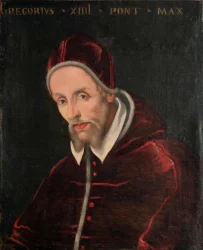
Urban V
Urban V was a reform-minded Benedictine who attempted something no pope had managed in more than half a century: returning the papal court from Avignon to Rome. He entered the city in 1367, hoping to restore the papacy’s presence in its historic center, but war and unrest made the move difficult to sustain. By 1370 he had returned to Avignon, where he died that December. His short Roman chapter did not end the Avignon Papacy, yet it set an important precedent for the later return of the papacy to Rome.
A monk and scholar becomes pope
Born Guillaume de Grimoard around 1310 in the Languedoc region of southern France, he joined the Benedictine order and built a reputation as a teacher, theologian, and administrator. He studied law and held positions in monasteries and church institutions, including serving as abbot of Saint-Victor in Marseille. His experience in religious life and diplomacy prepared him for the wider responsibilities of the papacy.
After Pope Innocent VI died in 1362, the cardinals elected Grimoard, who took the name Urban V. At the time, the papal court had been based in Avignon since 1309. Although the popes remained spiritual leaders of the Catholic Church, their distance from Rome affected their authority in the Papal States and left the city vulnerable to rival political powers. Urban’s election came as Italy was divided by warfare among cities, princes, and mercenary captains.
The return to Rome
Urban worked to strengthen church administration, encourage discipline among clergy, and support education. He backed schools and universities and sought to improve the moral standards of the church hierarchy. But his most ambitious project was to re-establish the papal court in Rome. On April 30, 1367, he left Avignon and traveled through Italy, finally entering Rome that October. He was the first pope in more than sixty years to reside in the city.
The return carried powerful symbolism, but Rome’s political and physical condition made it challenging. The city had suffered from instability and weakened infrastructure, and the pope faced opposition from cardinals and the French court. Italian territories were restless, and Urban lacked the military and diplomatic support that had helped secure the region. He nevertheless remained in Italy for nearly three years. In 1368, he met the Byzantine emperor John V Palaiologos in Rome, an encounter tied to hopes of renewed cooperation between the eastern and western churches and aid against Ottoman expansion.
By 1370, revolt and conflict across the Papal States made the Roman position increasingly precarious. Urban returned to Avignon in September, ill and discouraged, and died there on December 19. His departure disappointed supporters of a Roman papacy, but the effort showed that the return was possible. His successor, Gregory XI, later brought the papacy back to Rome in 1377.
A legacy of reform and unrealized ambition
Urban V’s pontificate combined spiritual reform with the practical demands of government. He cultivated learning, strengthened ecclesiastical institutions, and pursued a vision of papal authority grounded in Rome. Yet political instability prevented him from making the city a permanent seat of the papacy. The move he began would only become lasting under a later pope.
Remembered as Blessed Urban V, he was officially beatified in 1870. His legacy rests on the contrast between his ambitions and the limits he faced: a monk who sought renewal, a diplomat who tried to restore papal authority in Italy, and a pope whose return to Rome was brief but consequential. The Roman papacy was not restored in his lifetime, but his journey helped make that future imaginable.