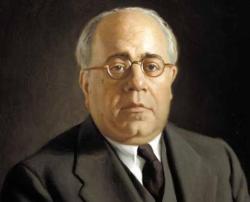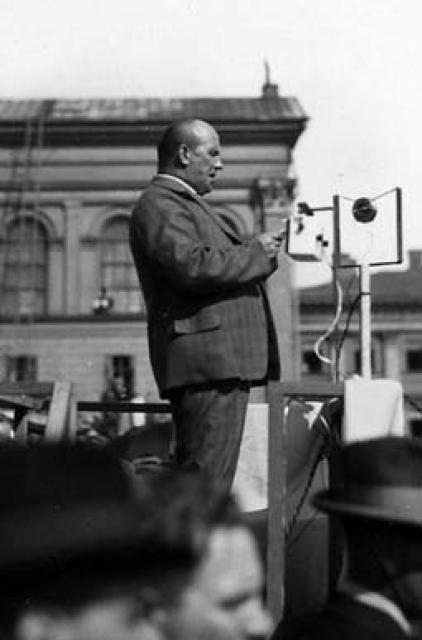
Vihtori Kosola
 Finland
- Vihtori Kosola: Founder and Leader of the Lapua Movement
- Involvement in the Jaeger Movement and Civil War
- Founder of the Lapua Movement
- Rise and Fall of the Lapua Movement
- Formation of the Patriotic People's Movement
Vihtori Kosola: Founder and Leader of the Lapua Movement
Vihtori Kosola, a prominent Finnish politician, was born on July 28, 1884, in the small town of Ylihärjä. His parents, Iisakki and Maria Kosola, moved to Lapua after their home in Ylihärjä burned down. Kosola's childhood and youth were spent in an agricultural environment, with his father dying when he was 15 years old, leaving him to manage the family farm entirely.
Involvement in the Jaeger Movement and Civil War
In 1915, the Kosola family's home in Lapua, which served as an inn, became a secret hub for transporting participants in the Jaeger movement to Germany. Kosola's younger brother was among the 250 Jaegers who passed through the house. When the Tsarist gendarmes discovered this, Vihtori Kosola was arrested and sent to Helsinki. He was later transferred to the Shpalernaya prison in Petrograd, while his wife, Elin, was imprisoned in Vaasa but later released on bail and ordered not to leave the country. Kosola remained in prison from February 1916 until the February Revolution in 1917, after which he returned to his farm in Lapua.
He later enhanced his agricultural skills at the Orisberg Agricultural College and participated in the Finnish Civil War, commanding a platoon in the province of Häme. He also joined the "fire brigade" in Lapua, a predecessor to the Finnish Defence Corps. After the Civil War, Kosola resumed farming.
Founder of the Lapua Movement
However, the political climate of the 1920s in Finland concerned him. Radical leftists organized political strikes in ports, aiming to disrupt foreign trade and destabilize the economy. To mitigate the effects of these strikes, the "Export Peace" organization was formed, and Kosola headed its district organization in Southern Ostrobothnia. In his hometown, he recruited workers to replace strikers, maintaining the country's essential economic functions. He even personally traveled to sites where labor was needed.
In November 1929, a Communist meeting in Lapua was disrupted by students, sparking a debate among locals about further action. Kosola initially favored restraint, but Magistra Hilja Riipinen argued for continuing resistance. A delegate meeting was held, where Kosola presented the situation and a delegation was chosen to meet with the president, government, and parliamentary groups in Helsinki. Kosola and Riipinen became prominent figures in the Lapua movement, attending all significant gatherings. Initially, Kosola belonged to the movement's moderate wing, but over time, he became more radicalized, possibly influenced by Riipinen.
Rise and Fall of the Lapua Movement
In the summer of 1930, a peasant march was organized, forcing the country's political leadership to recognize the movement's demands. The government resigned, and a new cabinet was formed that was more sympathetic to the popular movement. The movement's radical wing envisioned Kosola as a future head of state, with some even claiming divine inspiration. Rumors of a possible dictatorship also emerged, as Kosola was compared to Benito Mussolini, who had marched on Rome with his supporters.
Although the Lapua Movement had some influence in the new government, its parliamentary presence remained limited. However, parliament adopted laws against Communism, and the movement's support gradually declined. In his 1931 New Year's address, President Lauri Kristian Relander criticized the movement's lawlessness and disorder.
Formation of the Patriotic People's Movement
The failed Mäntsälä Rebellion in 1932 marked the end of the Lapua Movement. Kosola was arrested along with other movement leaders and imprisoned in Turku Prison. Following the banning of the Lapua Movement, discussions began about continuing its work in new forms. This led to the creation of the Patriotic People's Movement (IKL), which aimed to advance the policies of the Lapua Movement through parliamentary methods.
Kosola formally became the leader of the new movement, but the actual leaders were Vilho Annala and Bruno Salmiala, who distrusted Kosola due to his past and public image. The IKL differed from the Lapua Movement in its focus on parliamentary action and the inclusion of academics and former opponents. By 1936, Annala and Salmiala had taken over the formal leadership of the party, effectively ending Kosola's political career. He retired to his farm, saying, "The season ticket has expired." Two months later, he died of pneumonia. His unexpected demise eased the IKL leadership's handling of his removal from the party.