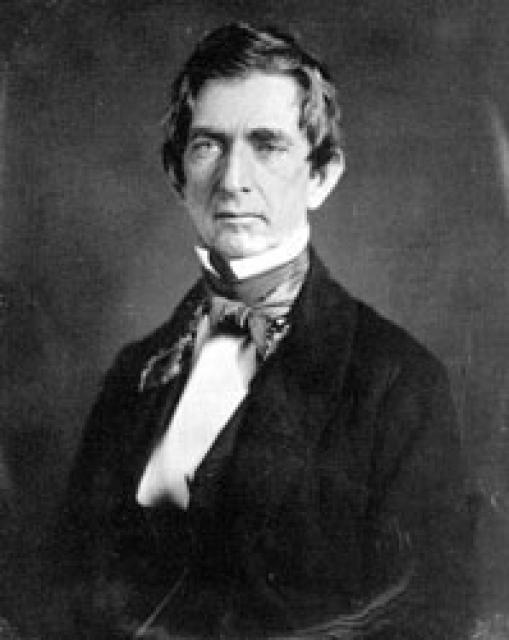
William Henry Seward
 USA
USABiography of William Henry Seward
William Henry Seward was born in 1801 in New York. He graduated from the Union College Law School in 1820 and practiced law for eleven years before leaving it for politics. In 1831, Seward was elected to the New York State Senate, and later became the governor of the state. In 1849, he began representing his home state in the United States Senate. Initially, Seward was a member of the Whig Party, but in 1855, he became a Republican.
In 1860, Seward competed against Lincoln for the presidential nomination. After Lincoln's victory, he offered Seward the position of Secretary of State, a role he held in both the Lincoln and Johnson administrations.
Seward was known for his anti-British and expansionist views. He considered John Quincy Adams his political mentor and fully supported his plans for the unity of North America and the United States. During the campaign for the presidential nomination, Seward delivered an expansionist speech, stating that Latin Americans, the English, and the Russians were merely laying the foundations for the future United States of America, with its capital in Mexico City.
On the night of Lincoln's assassination on April 14, 1865, Seward was also targeted. Lewis Powell, also known as Payne, broke into the Secretary of State's home, entered his bedroom, and inflicted several knife wounds on Seward and his eldest son, Frederick, who had come to his father's aid.
Fate had it that Seward would acquire a small territory on the Pacific coast for the United States - Russian America. His purchase of 586,412 square miles (1,518,800 square kilometers) for $7,200,000 (equivalent to $4.94 per square kilometer) was underestimated by his contemporaries. Journalists came up with various nicknames for the new land, ranging from "Seward's Icebox" to "Johnson's polar bear garden." Nowadays, Alaska celebrates Seward's Day on the last Monday of March.
After his resignation in 1869, Seward retired to his estate in Auburn, New York, and passed away in 1872.