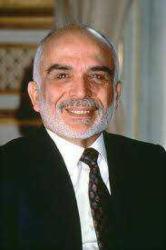
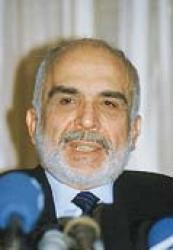
Ben Talal Hussein
 Jordan
Biography of King Hussein of Jordan
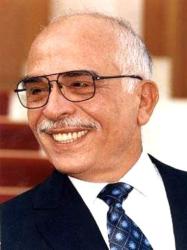
King Hussein of Jordan, who reigned from 1952 until his death, successfully guided his country through the Cold War and four decades of the Arab-Israeli conflict. He dedicated his life to achieving peace between Jordan and Israel, as well as between the Palestinians and Israelis. King Hussein was married four times and was born on November 14, 1935, in Amman. His parents were Prince Talal bin Abdullah and Princess Zein al-Sharaf bint Jamil. After completing primary school in Amman, Hussein attended Victoria College in Alexandria, followed by Harrow School in England, where he befriended his cousin Faisal II. He then enrolled in the Royal Military Academy Sandhurst.
An Assassination Attempt
On July 20, 1951, Prince Hussein traveled to Jerusalem to attend Friday prayers at Al-Aqsa Mosque with his grandfather, King Abdullah I. A Palestinian extremist, fearing that the king might engage in peace negotiations with the newly formed state of Israel, opened fire on him and his grandson. King Abdullah was killed, but 15-year-old Hussein survived and chased after the shooter. The assailant aimed his weapon at the young prince, but he was saved by chance as the bullet struck a medal on Hussein's uniform, given to him by his grandfather. In his autobiography, 'Uneasy Lies the Head,' Hussein recalls how three days before the fateful day in Jerusalem, his grandfather turned to him and said, "I hope you understand that one day you will have to shoulder the responsibility... I hope you will continue to serve our people."
Ascending the Throne
Hussein was appointed Crown Prince on September 9, 1951. His father, King Talal, became the King of Jordan but abdicated after a year due to a diagnosis of schizophrenia by European and Arab doctors. In 1952, a few weeks before his 17th birthday, Hussein was proclaimed the King of Jordan. He led Jordan through tumultuous years and maintained its reputation as an oasis of stability. After the Six-Day War, Hussein opened the Jordanian border, allowing over a million Palestinian refugees to enter and granting them Jordanian citizenship, along with access to education and healthcare.
The Pursuit of Peace
In 1991, King Hussein, in collaboration with the executive royal council, established the National Charter, which repealed martial law and proclaimed democratic principles. Opposition movements and political parties were legalized, and press freedom was affirmed. In 1994, he signed a peace treaty with Israel, with the participation of US President Bill Clinton. On March 13, 1996, the "Peacemakers' Summit" was held in Sharm el-Sheikh, Egypt, to redirect the Israeli-Palestinian peace process after a wave of suicide bombings in Israel. In his address to the summit participants, Hussein emphasized that those who use religious justification for committing acts of terrorism tarnish the image of Islam, which is, in reality, a peaceful religion.
Legacy and Final Days
In 1992, Hussein lost a kidney while battling cancer. Towards the end of his life, he learned about non-Hodgkin's lymphoma, which responded to chemotherapy, giving doctors a sense of optimism. On his way back to Jordan in January 1999, after receiving treatment abroad, the king stopped in London. Although doctors advised him to rest and stay in England for a few weeks, he refused, stating, "I desperately need to feel the warmth of my people surrounding me; there is much work to be done, and I will draw strength from my people to finish my mission." Shortly before his death, Hussein returned to an American clinic due to a relapse of typhoid fever, where he underwent a bone marrow transplant. However, the transplant was unsuccessful, and the king returned home, desiring to die on his homeland. On February 7, 1999, King Hussein passed away from complications related to non-Hodgkin's lymphoma. He reigned as king for over 46 years, devoting himself to the cause of peace in the Middle East.