Ernst Thalmann
 Germany
- Biography of Ernst Thalmann
- Early Life and Activism
- Opposition to Imperialist War and Revolutionary Activity
- Involvement in the November Revolution and Communist Party
- International Activism and Leading Role
- Antifascist Struggle and Imprisonment
Biography of Ernst Thalmann
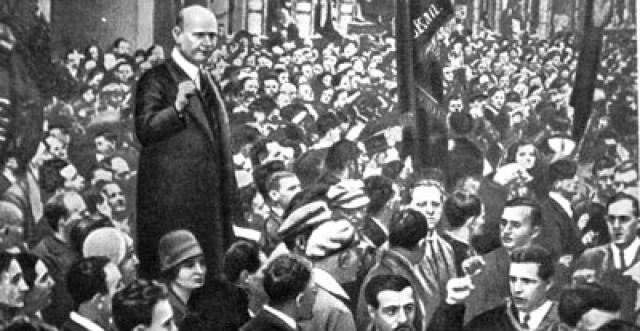
Ernst Thalmann (16.4.1886, Hamburg - 18.8.1944, Buchenwald concentration camp) was a German and international labor movement activist.
Early Life and Activism
Thalmann attended a public school from 1893 to 1900. He worked as a transport worker until 1923. From his youth, he joined the organized labor movement and became a member of the Social Democratic Party of Germany (SDPG) in 1903 and the transport workers' trade union in 1904. Thalmann played a role in organizing the youth trade union movement in Hamburg.
Opposition to Imperialist War and Revolutionary Activity
Before the outbreak of the First World War in 1914-18, Thalmann fought against the opportunist policies of trade union and social democratic leaders, aligning himself with prominent left-wing figures such as K. Liebknecht and R. Luxemburg. He consistently took an internationalist position and condemned the imperialist war. In 1915, Thalmann was mobilized into the army and sent to the Western Front. He faced persecution for his revolutionary activities within the army.
Involvement in the November Revolution and Communist Party
Thalmann actively participated in the November Revolution of 1918 in Germany as a member of the left-wing of the Independent Social Democratic Party of Germany (NSDPG). From May 1919, he led the Hamburg organization of the NSDPG and advocated for its integration into the Communist International (Comintern). When the NSDPG merged with the Communist Party of Germany (CPG) in late 1920, Thalmann and the majority of the Hamburg NSDPG members joined the CPG. He became the leader of the Hamburg organization of the CPG from December 1920 and was elected to the Central Committee (later Central Committee) of the CPG in May 1923.
International Activism and Leading Role
Thalmann's ideas, particularly his call for a decisive struggle against nationalism, which he considered the main ideological weapon of fascism, became part of the programmatic statement of the CPG in August 1930. He played a leading role in organizing the Hamburg uprising in 1923. Thalmann was elected chairman of the Central Committee of the CPG at the end of 1925 and aimed to transform the CPG into a disciplined, united, and closely connected Marxist-Leninist party. He also led the Red Front Fighters' Union from the beginning of 1925. Thalmann represented the CPG in the Reichstag from May 1924.
Antifascist Struggle and Imprisonment
In 1932, Thalmann's candidacy was put forward for the presidency of Germany. He became one of the leading figures of the Comintern, serving as a member of the Presidium of the Executive Committee of the Communist International (ECCI) and one of the deputy chairpersons. He participated in the 5th and 6th Congresses of the Comintern, as well as all plenums of the ECCI held from 1926 to 1932. Thalmann consistently defended the unity and cohesion of the Comintern. However, the rejection by the leaders of the Social Democratic Party of Germany (SDPG) of joint actions with the working class led to the strengthening of reactionary forces and the rise of fascism. After the establishment of the fascist dictatorship in 1933, Thalmann went underground and continued his struggle. He was arrested by the Gestapo on March 3, 1933, and imprisoned in various prisons until August 1944 when he was taken to the Buchenwald concentration camp and killed by direct order of Hitler and Himmler.
Through his wife Rosa Thalmann and his daughter Irma, Thalmann maintained constant contact with the Central Committee of the CPG, transmitting important instructions and information.