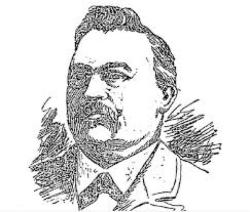
Frederick Cavendish
 Ireland
Lord Frederick Charles Cavendish was a British Liberal politician whose public career ended in one of the most shocking political murders of the Victorian era. Appointed Chief Secretary for Ireland in 1882, he was killed in Dublin’s Phoenix Park on his first day in the role, alongside senior civil servant Thomas Henry Burke. His brief Irish appointment, parliamentary service and close connection to Prime Minister William Gladstone made his death a national crisis.
Family and education
Cavendish was born on November 30, 1836, at Compton Place in Eastbourne, the second son of William Cavendish, the seventh Duke of Devonshire, and Blanche Georgiana Howard. The family belonged to Britain’s political and aristocratic establishment; his elder brother, the Marquess of Hartington, also held the office of Chief Secretary for Ireland.
Educated at home before attending Trinity College, Cambridge, Cavendish graduated with a Bachelor of Arts degree in 1858. In 1864 he married Lucy Lyttelton, a niece of Gladstone’s wife. Their marriage was childless, and Lucy survived him by more than four decades, later becoming known for her support of women’s education and Irish Home Rule. Cambridge’s Lucy Cavendish College bears her name.
A Liberal career in Parliament
Cavendish entered political work as private secretary to Liberal leader Lord Granville, serving from 1859 to 1864. In 1865 he was elected Liberal MP for the Northern division of the West Riding of Yorkshire, a seat he retained until his death. He remained in the Commons for seventeen years and contributed regularly to debates.
In 1872 he became Gladstone’s private secretary, serving during the prime minister’s first administration. He was appointed a junior Lord of the Treasury in 1873, and when the Liberals returned to office in 1880 he became Financial Secretary to the Treasury. Gladstone was then serving simultaneously as prime minister and Chancellor of the Exchequer, leaving Cavendish to handle much of the chancellor’s routine work. He also chaired the House of Commons Committee of Public Accounts from 1877 to 1880.
Cavendish’s personal qualities were often described favorably: colleagues regarded him as amiable, conscientious and industrious. He also had a speech impediment, which some biographers say limited his effectiveness as an orator. His family connections and closeness to Gladstone helped his advancement, and his appointment to a senior Irish post drew skepticism as well as support.
Ireland and the Phoenix Park murders
In May 1882, William Edward Forster resigned as Chief Secretary for Ireland amid disagreement over the government’s policy toward Irish nationalist leaders. Gladstone appointed Cavendish as his successor, believing his Treasury work on land purchase policy would help him advance a more conciliatory approach. The appointment came during a turbulent period of land agitation and political conflict.
Cavendish arrived in Dublin on May 6 and was formally sworn in that day. That evening, while walking in Phoenix Park with Burke, the permanent under-secretary for Ireland, he was attacked and fatally stabbed by members of the Irish National Invincibles, an extremist nationalist group. Burke was the intended target; Cavendish was killed in the attack as he accompanied him. Five men were later executed for their part in the murders.
The killings provoked widespread shock in Britain and Ireland and became known as the Phoenix Park murders. They abruptly ended Cavendish’s attempt to take up the post and cast a long shadow over efforts to reduce political violence. His funeral drew an enormous crowd, including hundreds of fellow MPs. The House of Commons record of his service—from parliamentary contributions to ministerial offices—captures a career that had steadily advanced before being cut short at age 45.