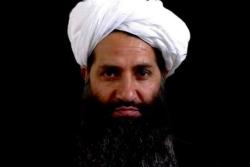
Hibatullah Akhundzada
 Afghanistan
- Early Life and Education
- Military and Political Career
- Rise to Leadership
- Head of the Islamic Emirate of Afghanistan
- Family
Early Life and Education
Hibatullah Akhundzada was born in 1961 in Panjwai district, Kandahar province, Afghanistan. He belongs to the Noorzai tribe of Pashtuns and comes from a poor and deeply religious family. His father, Mullah Muhammad Akhund, was a renowned theologian in his village and an imam in the local mosque. Relying on donations and tithes from parishioners, Akhundzada's family depended solely on religious activities.
Akhundzada received his early Islamic education from his father. Following the outbreak of the Soviet-Afghan War in 1979, he and his family fled to Pakistan and settled in Quetta near the Afghan border. There, he continued his religious studies and eventually became head of a madrassa.
Military and Political Career
In the 1980s, Akhundzada returned to the Soviet-backed Democratic Republic of Afghanistan and fought against Soviet forces as a mujahid. In 1994, he joined the nascent Taliban movement. As the Taliban captured the Iranian border province of Farah, Akhundzada was appointed head of the provincial ministry of the interior, responsible for combating crime.
After Kabul's capture in 1996, Akhundzada became a member of the Taliban's "Department for the Promotion of Virtue and Prevention of Vice." In the late 1990s, he relocated to Kandahar and served as a mullah and muhtasib (religious inspector) at a large madrassa and network of smaller hujras, where it is estimated that over 100,000 Taliban students studied.
Reportedly, Akhundzada had disagreements with the Taliban's leadership, leading to his relocation from Kabul to Kandahar. Following the US-led invasion in 2001, he became the head of the Taliban's council of religious scholars. He was also appointed Chief Qazi (judge) of the crumbling Islamic Emirate of Afghanistan's Sharia court and an advisor to Mullah Omar.
According to US intelligence, Akhundzada was primarily seen as a spiritual leader within the Taliban rather than a military commander. He was known for his oratory skills, extensive knowledge of Islam, and charisma. Akhundzada was responsible for most of the Taliban's fatwas and acted as a judge and expert in religious and ethical disputes within the Taliban.
Rise to Leadership
Akhundzada remained in Afghanistan after the coalition invasion, reportedly hiding in southern regions or near the Pakistan border. Taliban propaganda claimed he had not left the country from 2001 to 2016. In 2015, he was promoted to deputy leader of the Taliban.
Akhundzada's leadership saw the introduction of an internal security system, where commissions of "righteous Muslims" were established under provincial governors to investigate and punish abuses by commanders and fighters.
On May 25, 2016, Akhundzada was appointed Supreme Commander and Leader of the Taliban. He named Muhammad Yaqoob and Sirajuddin Haqqani as his deputies. Mullah Omar reportedly named Akhundzada as his successor in a deathbed will.
Head of the Islamic Emirate of Afghanistan
Akhundzada has not appeared publicly since his appointment, and there have been unconfirmed reports of his death, including from COVID-19. In May 2021, Akhundzada called for the withdrawal of US troops and the establishment of an Islamic state. Taliban forces under Akhundzada's nominal command launched an offensive, seeking a final victory in the war.
On August 15, 2021, the Taliban seized control of Kabul, marking the complete takeover of Afghanistan and the rebirth of the Islamic Emirate of Afghanistan. In August 2021, Akhundzada reportedly arrived in Afghanistan and held discussions in Kandahar on the formation of a future government.
Family
Little is known about Akhundzada's family. He reportedly had a son named Abdul Rahman, who was killed in July 2017 when a suicide bomber attacked an Afghan army base in Helmand province.