Huan Peron
 Argentina
Juan Peron: President and Dictator of Argentina
Juan Peron was the President and Dictator of Argentina from 1946 to 1955 and again from 1973 to 1974. Born into a middle-class family, Peron attended the National Military Academy in his youth and rose through the ranks from junior officer to teacher of military history, eventually being appointed as a military attaché in Chile and Italy.

In 1941-1943, Peron was one of the leaders, if not the head, of the so-called Group of United Officers, who advocated for a "Great Argentina" and openly supported the Nazis. In June 1943, with Peron's participation, senior military officials carried out a coup d'état. General Pedro Ramirez, who came to power, dissolved the parliament, banned many political parties, imposed censorship, and expelled officers from the army who belonged to opposition organizations.
Peron, who held positions as Minister of Labor (1943-1944), Minister of War, and Vice President (1944-1946), soon realized that the military regime needed a social base. Based on consultations with union leaders, a program of social reforms was developed. Peron actively encouraged the creation of new trade unions and implemented labor and social security law reforms. He personally benefited from his activities in October 1945 when a group of officers removed him from the position of Vice President. Peron was imprisoned, and the unions effectively blockaded the capital. The rebel officers were unable to form a government and were forced to release him. On February 24, 1946, Peron won a convincing victory in the presidential elections.
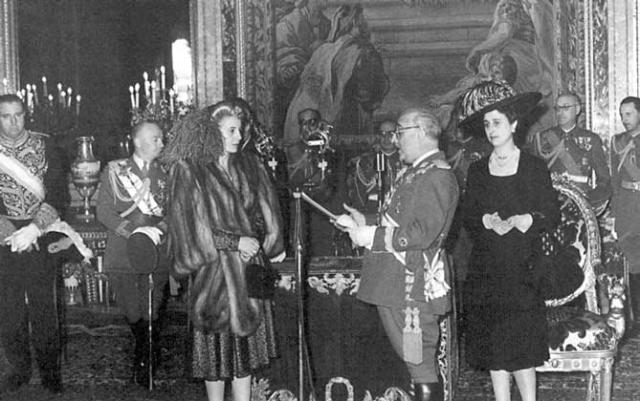
As president, Peron proposed a new set of labor and social security laws and implemented a program of industrialization for the country. Fixed prices were introduced for agricultural products. Freedom of speech was limited, and the educational system was subordinated to the goals of Peronist propaganda. Civil servants were encouraged to join the Peronist Party, which was established in 1947. With the help of his wife, former actress Eva Duarte (1919-1952), Peron purged the unions and replaced almost all the leaders who had contributed to his rise to power. However, most workers still saw him as their benefactor, and the unions remained a pillar of the dictatorship, along with the army, which had also been purged.
However, dissatisfaction with Peron's rule grew within the military. The patience of the military came to an end in 1954 when Peron came up with the idea of gaining control over the church. After a failed mutiny in the navy in June 1955, Peron slightly eased his grip on power, but soon tightened it even more than before. A new mutiny by sailors, which erupted in September of the same year, was supported by the air force and army units. Peron was forced to resign and went into exile.
While in exile, Peron continued to participate in Argentine politics through his supporters, providing them with money and instructions. During the 1958 presidential elections, Peronists formed the Justicialist Party and fielded their candidate, Arturo Frondizi. In the 1962 elections, they managed to win several governorships and become the largest faction in Congress, but the election results were soon annulled, and the Justicialist Party was banned. General Alejandro Lanusse, who seized power in 1971, promised to hold elections and legalized banned political parties. Although Peron was denied the right to run for president, he returned to Argentina in 1972 but left again after a few weeks without being able to resolve the disagreements among his supporters.
In the 1973 elections, the candidate endorsed by Peron, Hector Campora, emerged victorious. In June 1973, Peron returned to Argentina. Campora resigned, and in the new elections held in September 1973, Peron received 62% of the votes and became president, with his second wife, Maria Estela Martinez de Peron, serving as vice president.