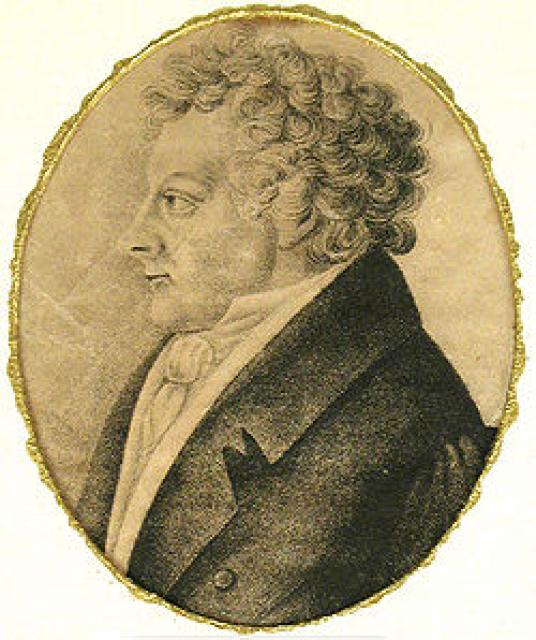
Johann Meckel
 Germany
Biography of Johann Meckel
Johann Friedrich Meckel was a German physician and biologist who made significant contributions to the field of comparative anatomy. He was born on October 17, 1781, in Halle, Germany. Meckel began his education at the University of Halle and continued his studies in Göttingen, Würzburg, and Vienna.
After completing his medical degree in Halle in 1802, Meckel furthered his knowledge by studying in Italy, France, and England. In 1806, he was appointed as a professor of anatomy and surgery at the University of Halle, a position he held until his death.
Meckel's efforts transformed Halle into a scientific center for comparative anatomy in Germany. The Museum of Comparative Anatomy, which was established by Meckel's grandfather, expanded its collection under Meckel's guidance and became the finest in the country. As a result of his outstanding work, Meckel came to be known as the "German Cuvier," in reference to the renowned French anatomist Georges Cuvier.
Among Meckel's numerous scientific works, his comparative studies on the development of the nervous system, gastrointestinal tract, skeleton, and circulatory system of vertebrate embryos, as well as the structure of the avian brain, are particularly well-known. During this period, the idea of comparing successive stages of development in higher animals with a "ladder of beings" gained significant popularity. Meckel constructed such series based on the laws formulated within his system of comparative anatomy.
Meckel believed that the animal kingdom was governed by the laws of diversity and unity. The law of diversity determined the development of an organism and encompassed the characteristics that distinguish one animal form from another. This law included not only the defining traits that give rise to species, genera, and subclasses but also the properties of individual organs in different animals, depending on age, heredity, and lifestyle. The law of unity, or reduction, viewed the vast array of animal forms as variations of a primary form. This gave rise to the theory of parallelism, which stated that modern higher animals pass through stages of development similar to those of lower animals.
Meckel's seminal work, "System der vergleichenden Anatomie" (System of Comparative Anatomy), published in seven volumes from 1821 to 1833, established the foundation of comparative anatomy as a scientific discipline. Additionally, from 1815 to 1823, he served as the editor of the "Deutsches Archiv für die Physiologie" (German Archive for Physiology).
Johann Meckel passed away in Halle on October 31, 1833, leaving behind a lasting legacy in the field of comparative anatomy. His groundbreaking research and writings continue to inspire and inform scientists to this day.