Mamadou Dia
 Senegal
- Mamadou Dia: Senegalese Statesman and Economist
- Political Beginnings
- Senator and Deputy
- Economic Theorist
- Towards Senegalese Independence
- 1960 Coup d'État
- Prime Minister of Senegal
- Downfall
- Legacy
Mamadou Dia: Senegalese Statesman and Economist
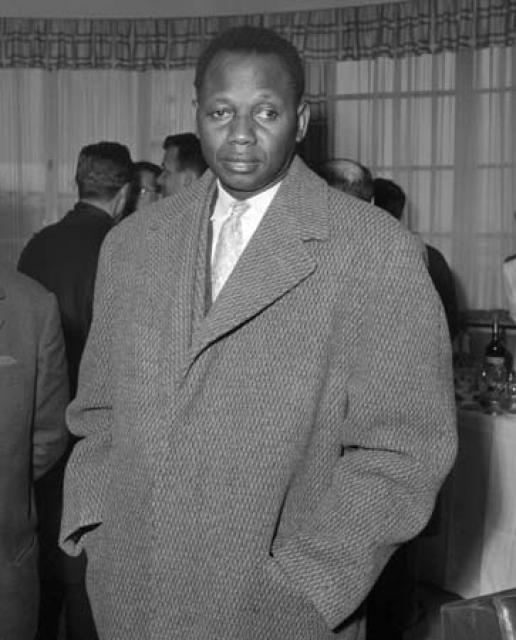
Early Life and EducationMamadou Dia, a Senegalese political leader, journalist, and economist, was born on July 18, 1910, in the small town of Kombol, Senegal. Despite facing discrimination as a "subject" due to his family's lack of full Senegalese citizenship, he received an excellent education thanks to his father's military service and his teacher's support. Dia attended local Islamic and regional schools before studying at the prestigious École William Ponty in Dakar and later earning a degree in literature from the Sorbonne in Paris.
Political Beginnings
Initially uninterested in politics, Dia became involved in public discourse and began publishing articles advocating for African farmers, describing rural poverty, and promoting agricultural cooperatives. After the fall of Vichy France, Dia joined the French Socialist Party (SFIO) but later left, claiming he only used it for support. He was elected to the French-West African Grand Council and became a leading figure in the Senegalese Democratic Bloc, founded by Léopold Sédar Senghor and Ibrahim Seydou Ndaw.
Senator and Deputy
In 1948, Dia was elected to the French Council of the Republic. He served two terms, advocating for African issues and opposing Germany's admission to NATO. In the 1956 French parliamentary elections, Dia was elected to the National Assembly, where he raised concerns about the Algerian conflict and economic development in overseas territories.
Economic Theorist
During his time in France, Dia pursued his economic studies. He published several influential works, including "Reflections on the Economics of Black Africa" (1953) and "African Economics" (1958), which presented his views on economic growth, self-reliance, and social justice in Africa.
Towards Senegalese Independence
In 1956, the French National Assembly passed the "Framework Law," granting Senegal greater autonomy. Dia became Vice-President of Senegal's Government Council and formed the first Senegalese government. He resisted external interference, relocated the administrative capital to Dakar, and clashed with French President Charles de Gaulle over the country's independence.
In 1958, Dia became President of the Government Council of the autonomous Republic of Senegal. He played a key role in the creation of the Mali Federation with neighboring Sudan and negotiated its independence from France in 1960. However, the federation dissolved after only two months due to conflicts between Dia and Sudan's Modibo Keita.
1960 Coup d'État
On August 20, 1960, Dia led a coup d'état against Keita, who had dismissed him from his federal government position. Dia declared Senegal's independence, dissolved the Mali Federation, and arrested Keita's supporters.
Prime Minister of Senegal
As Prime Minister of Senegal, Dia held extensive powers and supervised the country's economic development. He implemented a four-year plan, modernized the administration, encouraged foreign investment, and promoted social equality. Dia played an active role in foreign policy, fostering relations with various countries, including Eastern Bloc nations.
Downfall
Dia's growing assertiveness, particularly in the economic sphere, is believed to have led to his downfall. In 1962, Senghor accused him of attempting to establish a dictatorship and orchestrated his arrest. Dia was imprisoned for 12 years before being released in 1974. He died in 2009 at the age of 99.
Legacy
Mamadou Dia is remembered as a visionary leader who fought for African independence and economic development. His economic ideas, particularly his emphasis on self-reliance and social justice, continue to influence policy discussions in Africa and beyond.