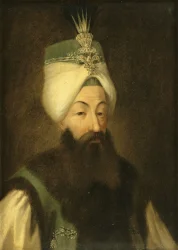
Murad III
 Ottoman Empire
Murad III ruled the Ottoman Empire during a period of military expansion, diplomatic maneuvering, and growing pressure on the imperial treasury. A poet as well as a sultan, he presided over a court that produced lavish illustrated histories and manuscripts. His reign saw Ottoman armies gain ground against Safavid Iran, while political influence at the palace shifted among powerful advisers and members of the imperial household.
A Prince of the Ottoman House
Born in 1546, Murad was the son of Prince Selim, later Sultan Selim II, and Nurbanu Sultan. He spent his youth in Manisa, where Ottoman princes received provincial training before succession. When his father died in 1574, Murad became the twelfth Ottoman sultan. His mother remained an influential figure in court politics, as did his consort Safiye Sultan. The role of royal women in this period was significant, though later accounts sometimes simplified complex political relationships into stories of harem intrigue.
In the early years of his reign, the grand vizier Sokollu Mehmed Pasha continued to oversee much of the empire’s administration. After Sokollu’s assassination in 1579, competition among ministers and court factions intensified. Murad was a more sedentary ruler than some of his predecessors, governing largely from Istanbul while commanders led campaigns across distant frontiers.
War with Safavid Iran
In 1578, Ottoman forces entered a long war with Safavid Iran, taking advantage of instability after the death of Shah Tahmasp I. The campaigns carried Ottoman power into the Caucasus and across parts of Iran. In 1585, Ottoman troops captured Tabriz, a major center of commerce and culture. The war was costly, but the 1590 Treaty of Istanbul confirmed important territorial gains for the Ottomans, including control over areas in the Caucasus.
The conflict formed one part of a wider imperial challenge. The vast state had to supply armies, manage distant provinces, and balance growing expenditures against revenue. Inflation and currency pressures troubled the later years of the reign, while the beginnings of a prolonged war with the Habsburgs in 1593 added another demand on Ottoman resources. Murad died in 1595, leaving the throne to his son Mehmed III.
A Sultan and Poet
Murad also cultivated a literary persona and wrote poetry under the pen name Muradî. His court supported calligraphers, painters, historians, and book artisans. Illustrated chronicles and religious manuscripts produced during his reign reveal the high level of Ottoman book arts and the sultan’s close interest in cultural production. The artistic energy of the palace flourished even as military costs and political strain weighed on the state.
Murad III’s legacy is therefore more layered than a simple tale of decline or palace politics. His reign expanded the empire’s eastern frontier, supported a rich court culture, and exposed the mounting fiscal and administrative challenges of ruling a vast multiethnic state. The sultan’s world joined poetry and power, but its successes depended on institutions and ministers as much as on the ruler himself.